Location economics and portfolio
We carried out a P&L analysis per store and assessed the break-even point (BEP) and return on investment (ROI), format sizes, space productivity and the potential of individual locations.
Case Study 01
Rebuilding the business model of a premium retail chain in formal restructuring
Location economics, leases, the offer, inventory, brand, e-commerce and the operating model were redesigned as one coherent recovery programme.
A selected transformation experience underlying HEFT7. The project predates HEFT7 and was led by the founder in the role of Transformation & Restructuring Director.
Key elements of the project
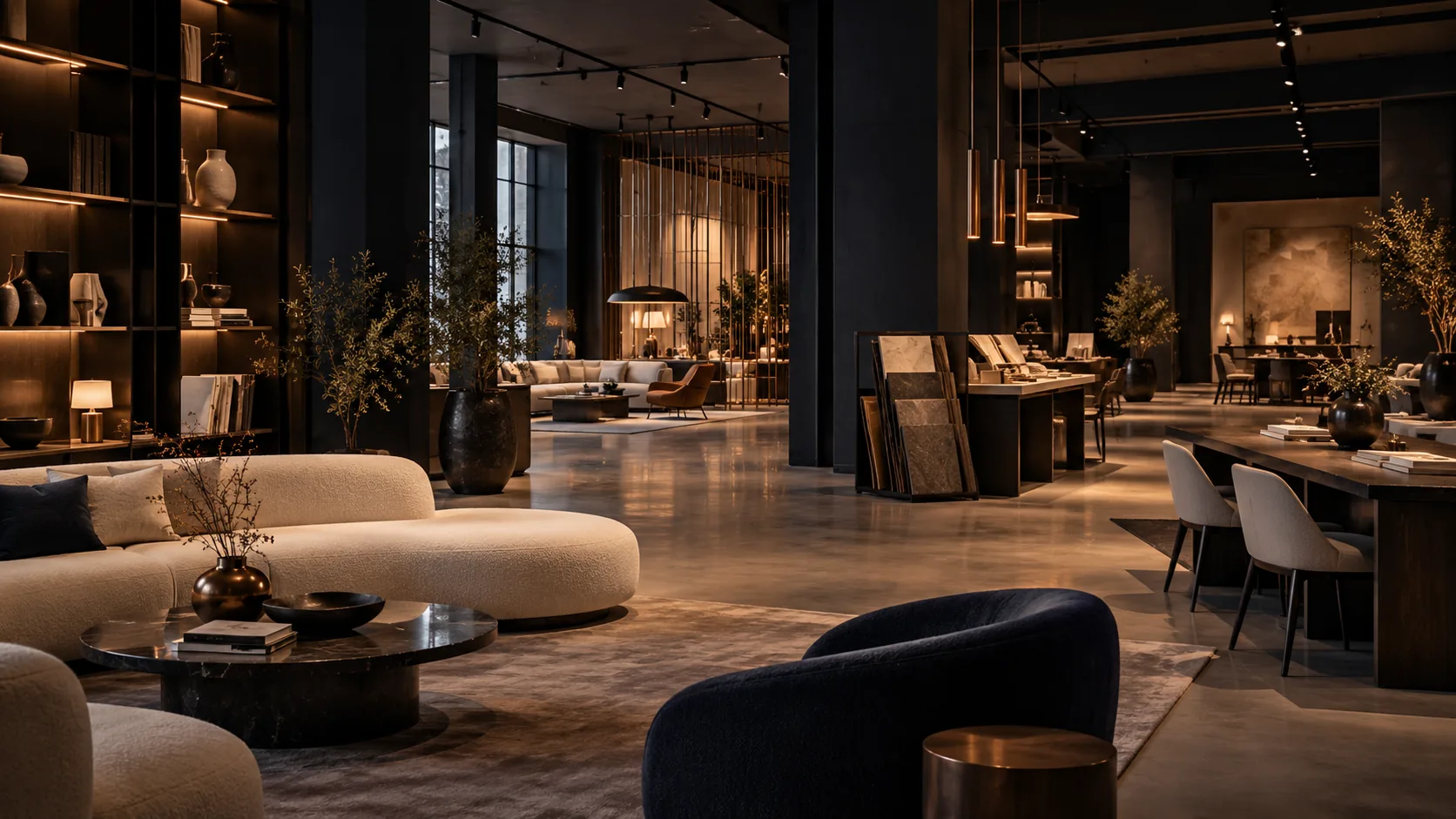
Illustrative image. It does not show a store covered by the project.
01
A Central European premium brand in the furniture and interiors sector entered formal court restructuring after a sharp deterioration in liquidity and operating results.
The company had historically operated 23 locations, but by the time the project began the chain had already been reduced to seven large-format stores, each exceeding 1,000 m². At an earlier stage the company had generated multi-million revenues and employed a team of significant operational scale.
The business model was under pressure from several directions at once. The company had lost its credit line, faced the need to redeem bonds and to pay a significant contractual penalty. Additional burdens were exchange-rate movements, the loss of part of its export markets, problems at one of its key counterparties and rigid lease terms.
Sales in the first half of one of the key periods fell by more than 20% year on year. At the same time the company held a significant level of inventory, and the liabilities covered by the restructuring involved more than 100 creditors.
02
The profitability of the remaining stores was also deteriorating quickly.
The store result fell from around 11% of sales to below 1% within about 18 months. Rent and service charges were approaching 20% of sales, and gross margin had fallen by about 5 percentage points over several years. Some locations were unprofitable.
However, the problem was not only about costs.
Large stores required wide display and a high level of stocking. Excess inventory froze capital and led to frequent promotions. Promotions eroded margin and weakened the premium positioning. A deteriorating perception of the brand reduced sales per square metre, which in turn deepened the problem of high, rigid rent costs.
Improving profitability required linked changes in store format, the offer, inventory and lease terms.
At the same time some suppliers expected prepayments, which limited the ability to refresh the offer. The architects' channel — important in the premium segment — was losing significance, and online sales remained insufficiently developed.
Cutting costs alone would therefore only reduce the scale of the existing problem, without removing its sources.
"Cutting costs alone may only create a smaller version of the same problem."
03
The project began with an analysis of the business economics.
Five years of P&L were analysed for every location, covering sales, cost of goods, gross margin, rent, service charges, salaries, marketing and store result. The analysis showed large differences in profitability between individual stores and a concentration of the result in single locations.
In parallel we assessed the level and structure of inventory, actual delivery lead times, the economics of working with suppliers, dependence on imports, store floor space relative to potential sales, brand positioning, the role of the architects' and B2B channel, service standards, the reporting system, CRM and operating processes.
In the inventory area we determined the level justified by the scale of sales and delivery lead times. The surplus was significant, and part of the stock was slow-moving, incomplete or very old.
The diagnosis showed that the company did not need a single corrective action, but a rebuild of interdependent elements of the model.
04
On the basis of the diagnosis, eight key decisions were defined.
The brand was to move away from the image of "premium, but constantly discounted" towards a more coherent, curated premium positioning.
The plan assumed a move away from very large stores towards formats of several hundred square metres, plus smaller temporary and pop-up formats.
A broad and inconsistent range was to be replaced by a narrower, deeper and more selective offer.
New partner brands and suppliers were to join the offer and, in the longer term, a higher-margin own brand was to play a larger role.
The online channel was to stop being an add-on to the physical network and become one of the main pillars of sales. Stores were to play a greater role in experience, advice and conversion.
The model provided for a reduction in floor space and more flexible rent structures, including progressive rent and turnover rent.
Surplus stock was to be reduced, and new purchasing rules and stocking limits were to be tied to sales and seasonality.
The new model was to run on store P&L, KPIs, CRM, clearly defined processes, accountability and management standards.
05
We carried out a P&L analysis per store and assessed the break-even point (BEP) and return on investment (ROI), format sizes, space productivity and the potential of individual locations.
We conducted direct negotiations on reducing floor space, lease terms, short-term and long-term rent reductions, financial support for store refurbishment and more flexible rent models.
We redesigned the structure of the offer, prepared a multi-brand model and built new models of cooperation with European partner brands on new commercial terms.
We identified an excessive level of inventory, applied ABC classification, designed the product structure and architecture, an allocation system and stocking limits, and a policy for liquidating slow-moving stock.
A new visual identity, logo, brand book, claim, key visual and brand communication system were created.
We developed a new store concept based on distinct style worlds and zones dedicated to, among others, architects and premium customers.
We launched a new online sales platform linked to interior design and fit-out services, migrated products, introduced the offer of new suppliers and developed home staging.
About 100 operating processes were mapped, and process owners, schedules, reporting rules, a KPI-based bonus system, CRM requirements and working standards were defined. An ERP-class system was implemented and the data structure was organised for BI.
06
Within a few months the project moved from diagnosis and design to actual implementation.
On the organisational side, a map of about 100 processes was created, with assigned owners and launch dates. We developed a daily, weekly and monthly reporting system, store P&L and a bonus system taking into account, among other things, sales, conversion, UPT, ATV and margin.
In parallel, a CRM specification was produced covering the key sales and communication processes.
On the leasing side, new agreements were signed during the restructuring. In all stores the terms were renegotiated and the rent model was changed. The base rent per square metre was reduced and, alongside long-term rent reductions, short-term reductions were also obtained. The chain's total floor space was reduced by 28%.
Landlords also became financially involved in building the new store concept — their support in financing the refurbishment (refits) of premises was secured.
Paradoxically, the restructuring itself became the guarantee of continued cooperation. Shopping centres were often creditors of the company, and continuing the leases tied creditor to debtor and gave the landlord real influence over the course of the recovery. Proposals were also presented for a further reduction in floor space and a move to progressive rent or turnover rent.
Within a few months a new brand identity, brand book, store concept and new communication solutions were prepared. A new e-commerce platform was also launched, together with the products of new suppliers.
07
The project led to the preparation and implementation of the key elements of the new business model. The foundation was a restructuring plan in which business analytics, the lease model, the offer and inventory formed one coherent whole.
The confirmed results include:
08
Full implementation across the chain was not completed.
Delivery took place under formal restructuring, in which key decisions about the assets remained with the court-appointed administrator. A further factor was the later closure of shopping centres during the pandemic.
These circumstances halted the full roll-out of the new concept across the whole chain.
For this reason the case study does not attribute to the project any unconfirmed sales or financial results after the implementation ended.
09
In a restructured retail business, cost reduction alone is not enough if the offer, format, inventory, brand and lease terms remain inconsistent with one another.
Each of these elements affects the others.
A recovery programme should therefore cover, at the same time, location economics, inventory structure, the offer, the sales model, space costs and the way the organisation is managed.
The second lesson concerns governance.
Management takeaway
"A recovery plan is worth only as much as the real decision-making rights that allow it to be implemented."
In a formal restructuring, the question of who takes a decision, who can block it and within what time it can be executed should be part of the programme from day one.
10
11
Five-year P&L per location, analysis of store economics, inventory, suppliers, leases, brand and processes.
New positioning, smaller formats, a change in the sales model and in the role of e-commerce.
New store formats, a multi-brand model, the store concept, the lease model and the operating model.
Process map, accountabilities, schedules, CRM, KPIs, new lease agreements.
Rebranding, new e-commerce, new suppliers, lease renegotiations and preparation of the new store concept.
ERP, data structure and BI, reporting system, store P&L and KPIs built into the new management model.
Full stabilisation was not achieved owing to decision-making constraints and external conditions. This became one of the key lessons of the project.
If the profitability of a chain is deteriorating, individual cost actions may not be enough.
HEFT7 starts such projects with a diagnosis of the business economics and of the interdependencies between locations, margin, inventory, the offer, leases and the operating model.